Anvar JumabaevDeveloper · Builder · Problem solver</>
From concept to connected product.
CREATIVITY × ENGINEERING
01 / SELECTED WORK
Built with purpose.
Real products. Connected platforms. A few things I’ve brought to life.
TRAVEL & DISCOVERY2021–2024
GuideBook of Kyrgyzstan
Helping travelers discover Kyrgyzstan’s remarkable places. Its history spans a Django content API, native iOS and Android apps, and a newer Next.js website.
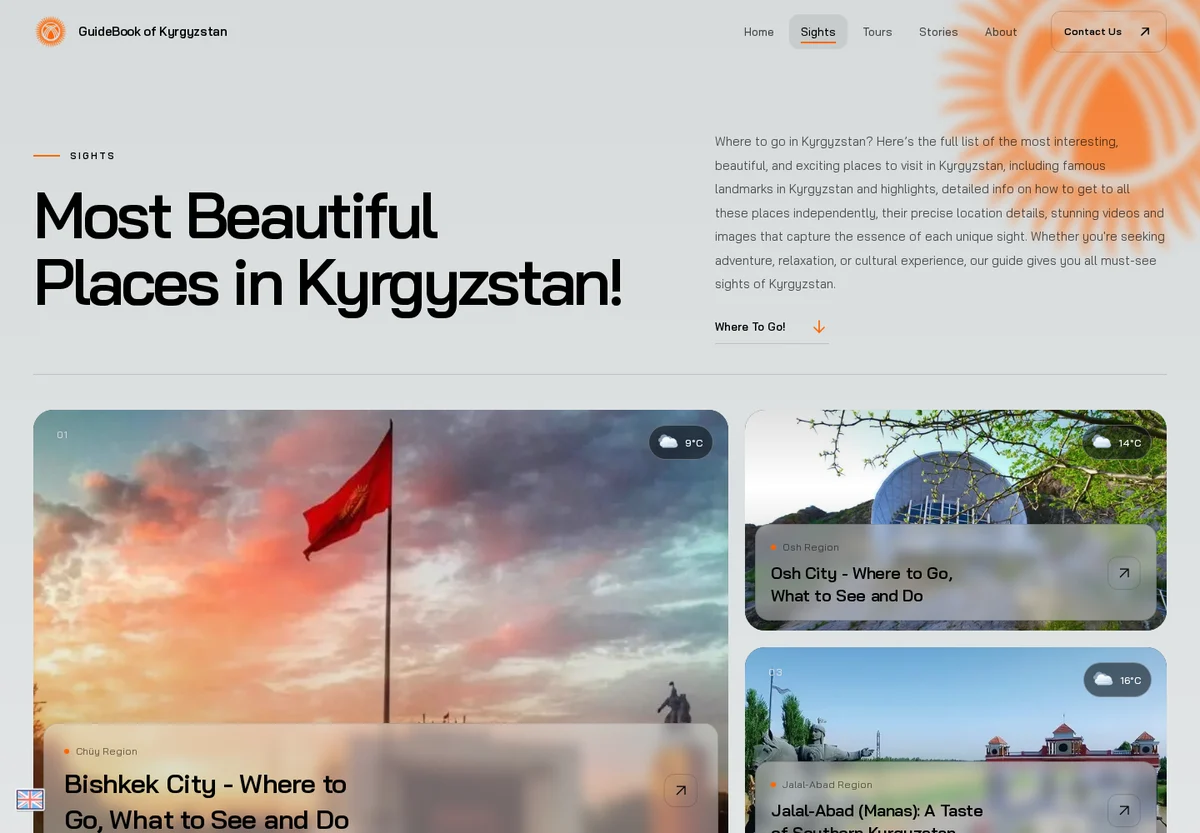
Real website captures. Native-app screenshots are not archived here.
01 / THE PROBLEM
Make discovery useful.
Travelers need more than a place name. They need context, location information, and a way to decide where to go next.
GuideBook presents destinations, tours, and travel content across web and mobile interfaces. The current Sights page groups destinations into a browsable visual guide.
My contribution
My project record covers the website, SwiftUI and Kotlin interfaces, REST APIs, and the services connecting them. The public Swift source identifies Anvar Jumabaev as its author.
PlatformsWeb, iOS, Android
Project record2021–2024 iterations
Verified public workSwiftUI source, Django REST endpoints, current website
02 / THE PRODUCT, AS IT IS
A real view of the web.
Captured from the current Sights page on 22 October 2026. The narrow view is the responsive website, not a native app screenshot.
The archived code and today’s website describe different stages. These implementation notes keep those stages distinct.
Native iOS snapshot: bundled data and observable state
The public Swift view model reads a bundled dataJson.json file, decodes cities, places, and tours, and exposes them through published properties. This snapshot establishes local JSON loading; it does not demonstrate a live API connection or offline synchronization.
The archived server defines GET views for place and tour lists and individual records, using Django REST Framework serializers. The separate list and detail endpoints give clients a clear boundary for content access. The project record describes Django-backed iOS and Android versions; their released binaries have not been audited here.
The current website and public repository establish a newer Next.js web application. The repository also contains a MongoDB helper. These facts do not establish that the historical mobile apps use the current web application’s database or endpoints.
These identifiers come from the original portfolio. Checks on 22 October 2026 returned 404 for the US and Kyrgyzstan Apple storefronts and the tested Google Play variants. Apple’s lookup API returned no record in those two regions. This does not establish worldwide availability or permanent removal.
Project illustration · No verified product screenshots are archived here.
Django RESTPostgreSQLSwiftUIKotlin
01 / THE PROBLEM
Find the right help.
People looking for help around the home need a practical way to find service professionals.
WeCan connects that search experience across a website and native mobile clients. The project record describes a shared Django server and notification integration.
My contribution
My portfolio records work on the responsive website, native SwiftUI and Kotlin interfaces, REST services, and the server behind them. The public WeCan repository contains the historical Django implementation.
PlatformsWeb, iOS, Android
Project record2023
Recorded stackDjango REST, PostgreSQL, SwiftUI, Kotlin, Firebase
02 / HOW IT CONNECTS
Three clients. One service boundary.
The documented 2023 system. Open a node to inspect its role. Client-to-service and PostgreSQL relationships come from the original project record; the public server source independently shows Django web and API routes.
The clients use the shared service; the server handles persistent data. Read each node for evidence and the limits of what is verified.
Website Django web
The server routes the web application through app.urls. It shares the Django project with the API.
iOS SwiftUI client
The project record describes an iOS search-service client using SwiftUI, Foundation, Firebase, and UserNotifications.
Android Kotlin client
The project record describes an Android client using Jetpack Compose, Retrofit, OkHttp, and Firebase Cloud Messaging.
Shared API Django REST Framework
The archived server exposes API routes under /api/. The original portfolio describes both mobile apps as clients of that Django server.
PostgreSQL is listed in the original website project record. Live hosting, database schema, and current operating status have not been verified.
Historical architecture from the portfolio record and public server routes. Each node is a native disclosure, usable by keyboard and touch.
03 / IMPLEMENTATION NOTES
Connect the pieces.
Separate web and API routes in one Django project
The route configuration includes the web application and an api/ namespace in the same project. This separates client-facing endpoints from website routes while retaining a shared server boundary.
The portfolio’s iOS record lists SwiftUI and Foundation; its Android record lists Jetpack Compose, Retrofit, and OkHttp. These are distinct native client implementations. The historical project record describes their connection to the Django server; released binaries are not available for independent inspection here.
Notifications are a separate integration
Firebase Cloud Messaging and iOS UserNotifications are named in the project record. That establishes the recorded notification stack, without asserting a particular delivery workflow, reliability figure, or current configuration.
04 / PROJECT HISTORY
An honest project record.
No verified WeCan product screenshots were supplied or found in the inspected public source. The artwork above is an illustration. A gallery will be useful when an authentic capture can be added.
These identifiers come from the original portfolio. Checks on 22 October 2026 returned 404 for the US and Kyrgyzstan Apple storefronts and the tested Google Play variants. Apple’s lookup API returned no record in those two regions. This does not establish worldwide availability or permanent removal.
I enjoy connecting the dots between a good idea, a useful interface, and the systems that make it work.
My work spans full stack web development and native mobile apps. With GuideBook and WeCan, I’ve built across the whole product: responsive websites, SwiftUI and Kotlin interfaces, REST APIs, and the servers that connect them.
I care about clear interactions and practical solutions. Whether it’s helping someone explore a new place or find a local professional, the goal is the same: make the next step easier.
01 Think about the user02 Connect the pieces03 Keep improving
MY EVERYDAY TOOLKIT
ReactNext.jsSwiftUIKotlinDjangoNode.js
03 / TOOLS OF THE TRADE
The right tools. The complete picture.
From what you see on screen to what happens behind it.
01
Web experiences
Responsive interfaces that turn complex features into clear, usable experiences.
JavaScriptReactNext.jsHTML & CSS
02
Native mobile
Purpose-built iOS and Android apps, connected to shared services and data.
Swift / SwiftUIUIKitKotlinJetpack Compose
03
Behind the scenes
APIs, databases, and deployments that bring the whole product together.
Python / DjangoNode.jsPostgreSQLMongoDBNginx / Linux
04 / WHAT’S NEXT?
Have an idea? Let’s make it real.
A web product, a mobile app, or a problem worth solving. Tell me what you have in mind.